
A family via ferrata is often a vivid memory for children: the drop, the rungs, the footbridge… and the pride of reaching the top. Provided you choose the right route and follow a few rules that are not the same as for adults.
From what age?
There is no official age: what matters is the child's height, weight andwillingness .
- Height : rungs and anchor points are placed for adults. Many via ferratas state a minimum height, often between 1.25 and 1.40 m for family routes, more for difficult ones. It is shown on the sign at the start and, when we know it, on our route pages.
- Weight : standard via ferrata kits are designed for about 40 to 120 kg. Below 40 kg, the absorber does not work as intended: the child must be belayed with a rope by an adult who masters the technique, or by a professional.
- Willingness : a scared or tired child struggles to move on. A short route enjoyed is better than a long one endured.
The right gear
- Helmet in their size, well adjusted, chin strap fastened.
- Harness : for young children, a full-body harness (sit harness + chest harness) is recommended, because their centre of gravity is higher and they could tip upside down in a simple sit harness. Follow the manufacturer's instructions for height and weight.
- Lanyard : a via ferrata kit suited to their weight if they are over 40 kg; otherwise, a rope in addition to (or instead of) the lanyard, handled by the adult.
- Gloves in their size, shoes that hold well, water and snacks within reach.
Details on roping up are in our Gear corner. If you can't belay with a rope, the safest solution is to go with a guide or instructor : they often provide children's gear.
Choosing the right route
- Grade F or PD, duration 1 h à 1 h 30 maximum for a first time.
- With one or more escape routes : turning back halfway with a child is often difficult.
- A short approach walk : energy should be saved for the route.
- fun sections (footbridge, monkey bridge, small ladder) rather than long vertical sections.
- In the shade in summer, and never in stormy weather.
A few ideas for family routes:
- Rocher du Saint-Julien – Buis-les-Baronnies (Drôme) · “La Pitchouno” route, PD, from 1.25 m
- Bellevaux (Haute-Savoie) · “Cascade des Nants” route, AD, from 1.40 m
- Die Burg – Neuerburg (Eifel) · F to PD, near Luxembourg
- SteBa – Dinant (Belgium) · F to PD
Always check the minimum height and opening on the sign at the start or with the tourist office.
On site: an organisation that works
- One adult in front of the child, one behind when possible: the one in front shows the moves, the one behind reassures and watches the carabiners.
- Buddy check before setting off, even more carefully for the child: helmet, harness, lanyard or rope, carabiners.
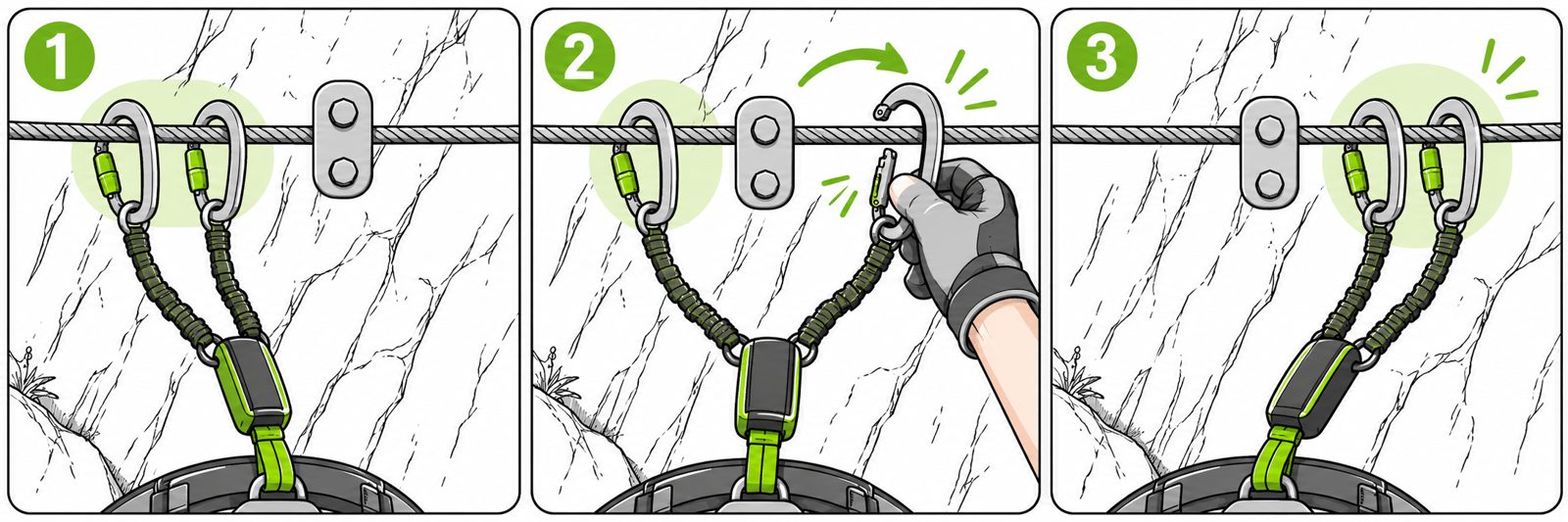
- The carabiner rule explained simply: “always one carabiner on the cable”. Have them repeat it at every anchor at first.
- Breaks at regular intervals, a snack, and encouragement: every footbridge crossed is a victory.
- No pressure : if the child wants to stop, take the escape route. They will still want to come back.
Safety
- No via ferrata in a storm; wet rock = slippery.
- Watch out for falling rocks: helmet always on, even during breaks at the foot of the rock face.
- In case of accident: 112 (and 1414 in Switzerland).
Before the outing, read our guide Getting started with via ferrata. And afterwards, tick off the route in your ViaTrek logbook and leave a review: other families will thank you.
Going further
Sources consulted: Swiss Alpine Club – via ferrata safety (children, minimum height, 20 m rope) · FFME – via ferrata recommendations (PDF, in French) · Petzl, “Access Book no. 3” booklet (lanyards not designed for under 40 kg; rope recommended).
This guide gives general advice. It does not replace training, the instructions posted at the start, or a professional's advice.